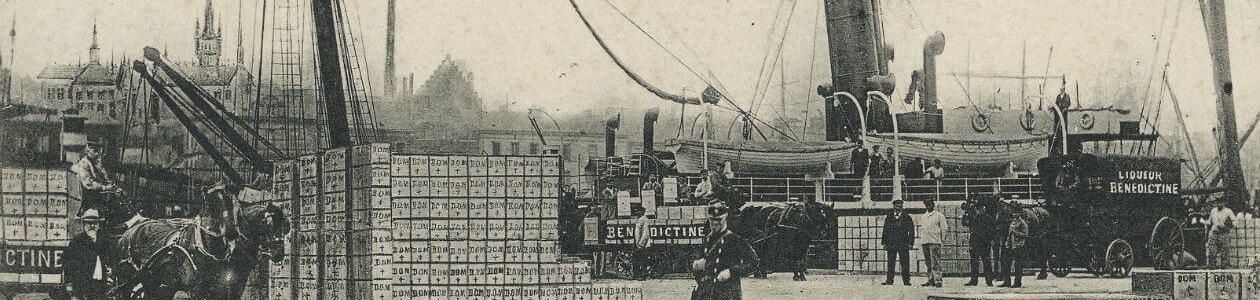
From the French Revolution to the “Thirty Glorious” Post War years, from the Crimean War to two World Wars, from the digging of the Suez Canal to the independence of countries in North Africa, from the economic crisis of 1929 to the heady days of the stock market…, the Maison Worms has pursued international activities that have diversified over the years to match the need to consolidate its existing business: from international trading in British coal to shipping services (coastal and ocean, oil) and on to ship building and banking services.
1: British coal trade and shipping
1801 - 1856 : Foundation of the Maison Worms
Merchant banker, Hypolite Worms (1801-1877), sets up in business with offices at 46, rue Laffitte, in Paris (1842). Begins international trading in British coal imports (1848) and establishes bases in France and Great Britain: Rouen, Dieppe, Newcastle (1848), Le Havre (1849) and Cardiff (1851). First contracts signed with the gas and shipping companies, the French State, the Compagnie des Messageries Maritimes and the railways, in France and abroad (1850-1856). Supplier of coal to the French Navy during the Crimean War (1854-1855). Involved in setting up the Anglo-French Steam Ship Company for the purpose of boosting traffic with Grimsby, where a branch is opened (1856). Launch of the Worms fleet: first two steamers, "Sephora" and "Emma", are ordered (1855) and commissioned (1856).
Opening of branches in Bordeaux (1857) and Marseilles (1858). First trials with Baltic shipping (1858) and gradual development of a national and northern European coastal shipping network: inauguration of the Bordeaux-Le Havre-Hamburg (1859) and Bordeaux-Antwerp (1869) lines. Supplier to the bunkering stations of European shipping companies in the Mediterranean, South America and the Far East (Tourane, Hong Kong, Shanghai, etc.). Maison Worms moves to 7, rue Scribe, in Paris (1864). Delivery of coal to the companies in charge of digging the Suez Canal (1865). Opening of a branch in Port Said (1869).
The firm became a general partnership under the name of Hte Worms & Cie (1874). Death of Hypolite Worms (1877), succeeded by Henry Josse (1818-1893) and Henri Goudchaux (1846-1916). Registered offices move to 45, boulevard Haussmann, in Paris (1878). The Port Said branch starts to offer banking services to clients; the Company is renamed Worms, Josse & Cie and conversed into a limited partnership; acquisition of F. Mallet & Cie, in Le Havre (1881), a firm of which H. Worms was a founding shareholder. Opening of a sales agency in Pasajes (1884) and a coal depot in Zanzibar (1885).
Branches opened in Bayonne (1887), Algiers (1891) and Buenos Aires (1892) to withstand the onslaught of competition. Financial guarantees provided for Marcus Samuel & C° for shipping tankers through the Suez Canal (1891). Henry Josse elected MP in the UK (1892-1893). Change of company name to Worms & Cie (1895). Development of the Port Said branch: concession to sell Shell oil products in Egypt, Palestine and Syria (1898). Acquisition of the Dieppe - Grimsby (1905) line, created in partnership with A. Grandchamp Fils, as well as Nantes - Bordeaux and Nantes - Bayonne services operated by L'Armoricaine (1907).
Temporary or permanent requisition of part of the fleet; destruction of 10 ships (on 19 at the beginning of the war); increase in UK coal imports (1914-1918). Death of Henri Goudchaux (1916); Hypolite Worms (1889-1962), grandson and namesake of the founder, takes over at the head of the Company. Conclusion of a contract with the French Ministry of the Navy under which the Company ensures a monthly transportation of 8,000 tons of coal from Wales to the port of Brest (1916). The large number of its ships torpedoed or sunk by the Germans obliges Worms to reduce this delivery to 6,000 tons. For this reason the agreement by which Maison Worms is committed to the French State to allocate 13 of its vessels to travel between Bordeaux and Dunkirk is reduced to 10 units. At the same time the Company puts its commercial organization in United Kingdom at the service of the French Administration and is mandated as a general agent to take over the management of vessels allocated to France by the Allied Committee (1917).
Construction of the Le Trait shipyards, in Seine-Maritime, at the request of the State (1917-1920) and launch of the yard's first ship, the "Capitaine-Bonelli", in 1921. At the time of the retirement in 1925 of Georges Majoux, managing partner since 1916 and particularly responsible for this sector, 24 ships had been built for the French Navy and various merchant shipping lines; village at Le Trait transformed into a garden-city, providing homes for 4,000 people.
Reconstruction of the fleet and emphasis on shipping services with northern Europe: branches set up in Rotterdam, Hamburg, Antwerp and Danzig, shipping lines with Germany, Poland, East Prussia and Russia (1919), establishment of bases in Warsaw, Prague and Duisburg (1920), services to the Baltic countries (1922). Marseilles-North Sea ports line launched in 1936 to offset the slump in traffic on the Baltic.
Expansion of the coal trade in the eastern Mediterranean and diversification of sources of supply: in 1937, British ore accounts for just 60% of the volumes imported by the Company, the rest coming from Germany, Poland, Belgium, Holland, Tonkin and Turkey. Distribution of liquid fuels from 1936. Jacques Barnaud joins the Company (1927) becoming managing partner in 1929. Launch of banking activities (1928), similar to those of the merchant banks: credits and discounts granted to customer companies in the fuel and shipping sectors, financial banking and advice for firms hit by the depression ("the crash of 1929") and those with major growth potential but lacking the necessary resources to modernise. For example, the Compagnie Havraise Péninsulaire through which Worms & Cie enters the world of deep sea shipping; companies such as Marret, Bonnin, Lebel & Guieu; la Lyonnaise des Eaux et de l'Eclairage; Omnium Colonial; Félix Potin; Air France; the Société d'Entreprises de Grands Travaux Hydrauliques; Entreprises Albert Cochery; the Société des Transports Maritimes Pétroliers; La Préservatrice; Japy Frères; Manufacture Centrale de Machines Agricoles Puzenat. The team masterminding the reorganisation of all these companies is headed by G. Le Roy Ladurie and R. Meynial and, in 1938, it completes a major national transaction with the foundation of the Société Française de Transports Pétroliers, Semi-public companie, combining private initiative with the power of the State.
Staff based in northern Europe recalled to France and requisition of the Worms, Nochap, SFTP and STMP fleets (1939). Shipping and fuel services halted and certain administrative functions transferred to Nantes; Le Trait shipyards evacuated; signature of the "Worms agreements" transferring to Britain the two million tons of neutral vessels chartered by Hypolite Worms on behalf of France (1940). Campaign against Worms & Cie in the collaborationist press; company placed under the control of a German administrator and the Le Trait shipyards under the Kriegsmarine. Opening of banking branches in Marseilles and Algiers (1940-1941).
Replacement of the coal business by the supply of peat, forestry and sawmill products (1941). Bombing of Le Trait (1941-1943). Seizure of the Algiers branch by the Comité Français de Défense Nationale (1943), threat of further seizures in France (1944). Robert Labbé, the grandson of Henri Goudchaux, and Raymond Meynial join the executive (1944). Legal action taken against H. Worms and G. Le Roy Ladurie, for "economic collaboration with the enemy": the Court of Justice of the Seine, in 1946, and the Commission of Epuration, in 1947, dismissed the charges on the grounds that there was no case to answer.
The Le Trait shipyards become a limited company under the name of Ateliers et Chantiers de la Seine-Maritime (1946). Coal importing activities cease with the French State's decision to grant the Association Technique de l'Importation Charbonnière (ATIC) a monopoly in this field (1948); distribution of petroleum products and participation in the foundation of Antar. Acquisition of a stakeholding in La Foncière Transports (1949).
Extension of shipping operations in northern Europe, the Mediterranean and Indian Ocean.
Via the Ciave, the banking division organises the first funding operations for turnkey plant abroad.
Establishment of Worms Compagnie Maritime et Charbonnière (1957), the subsidiary henceforth in charge of running the company's two historical businesses.
Death of Hypolite Worms and Jacques Barnaud (1962) who are succeeded by Raymond Meynial (1902-1996).
Start of the decolonisation period: closure of branches in North Africa, creation of joint subsidiaries with the new independent national governments, development of services for foreign shipping lines.
Modernisation of the shipping companies controlled by Maison Worms: commissioning of the first container ships and supertankers (VLCC).
The Banking Department becomes an independent entity, the Banque Worms & Cie (1964), opened to foreign investors (1967).
Involvement in the Compagnie Bancaire (1966), set up in 1959 by Jacques de Fouchier to group together the various financial services.
Takeover of the Le Trait shipyards by the La Ciotat shipyards (1966).
Shutdown of shipping lines under the Worms flag; foundation of Unibail (1968) and entry into the world of property leasing.
Extension of the network of Banque Worms branches in France and abroad.
Continuation of financial transactions through subsidiaries such as the Banque de Gestion Privée - BGP - and Banque Worms & Cie (Suisse), and subsequently redeployment via Demachy Worms & Cie (1983-1989).
Transformation of Compagnie Navale Worms into the Compagnie Nationale de Navigation - CNN, following its acquisition from Elf (1986).
Consolidation of the agricultural foodstuffs companies (Générale Sucrière, Lesieur, etc.) and papermaking companies (Arjo Wiggins Appleton established in 1990 by the merger between Arjomari Prioux and Wiggins Teape Appleton Plc) under Saint Louis (1986-1991).
Conversion of Worms & Cie (1987) and Pechelbronn (1989) into incorporated partnerships. Establishment of Athena Assurances (1989) bringing together PFA (result of the 1984 merger between La Préservatrice and La Foncière), GPA and La Lilloise.
Development of asset management activities in New York under the name of Permal.
Merger of Pechelbronn and Simer (1991) under the name of Worms & Cie, while the former Worms & Cie is renamed Maison Worms & Cie.
The Group's share capital is quoted on the Paris stock exchange, attracting investors such as Ifil (Agnelli Group - 1990), Temasek Holdings Pte (investment company owned by the government of Singapore - 1992), and the Abu Dhabi Investment Authority (1992).
Link-up of Euronav (Worms tankers division) with the Compagnie Maritime Belge; consolidation of Arc Union with Unibail (1995). Maison Worms & Cie (1996) and Saint Louis merged with Worms & Cie, which becomes a limited company with a two-tier management structure (1997).
Sale of Demachy Worms & Cie to ABN-Amro, of Athena Assurances to AGF and of CNN to the Compagnie Maritime Belge (1997-1998).
Transfer of Permal shares to Legg Mason (2005) and of SGS shares directly to the shareholders of Worms & Cie (2006). Concomitantly, disengagement of the "paper" branch exploited under the name of Sequana.
Development in two sectors (since 2006):
- one, traditional: the shipping agency, through Worms Services Maritimes, a company which, by its expansion in Egypt, North Africa and France, continues the work begun by the founder of the Maison Worms in the 1850s,
- and the other, new: the design of management risk solutions involving Testing, Inspection and Certification Services through Worms Safety, which, over a decade, formed an alliance of companies operating worldwide.